
Toothsome dishes leave people happy. So will Soukarya Ghosal’s indie food fantasy Rainbow Jelly, which cooks Bangaliyana (Bengali-ness) to perfection. The film — written, animated and directed by Ghosal — was screened recently at the Hyderabad Bengali Film Festival at Prasad Labs. In its fifth week in Kolkata, the film is running to packed theatres, and was also screened at Delhi’s Habitat Film Festival and Bengaluru’s Bengali Kannada Film Festival. What makes the film special is that the food fantasy, perhaps India’s first, is about an orphaned special child, played by a real-life special-needs child, Mahabrata Basu.
Ghoton (Basu), bent over his colouring book on the kitchen floor, rushes to the terrace hearing the sound of aeroplanes flying overhead, drifting into his kingdom of dreams. The tea had long boiled and spilled over the gas, and the burnt smell makes his maternal uncle (Kaushik Sen), trimming his moustache, come down heavily on the 13-year-old.
He lives in servile conditions with his uncouth, sloth uncle, called Gondariya (of gondar/ rhinoceros, thick-skinned), who eats, drinks, sleeps and scowls when the food tastes bad or the robot rejects his passwords. He speaks with a lisp. The comic villain concept is inspired from Satyajit Ray’s children films, like Mandar Bose in Sonar Kella (1971). Ghosal, 32, attributes this training to author Leela Majumdar, to whom he dedicates the film. That in children’s stories, the villain shouldn’t be overarchingly fearsome, the kids should feel they can defeat it. “I like anti-casting,” Ghosal says, adding, “Casting Kaushik, who usually does dignified roles, seemed fascinating. I worked with his son Riddhi in my last film (Load Shedding) in 2015.” Ghosal’s first was Radhika Apte-starrer Pendulum in 2014.
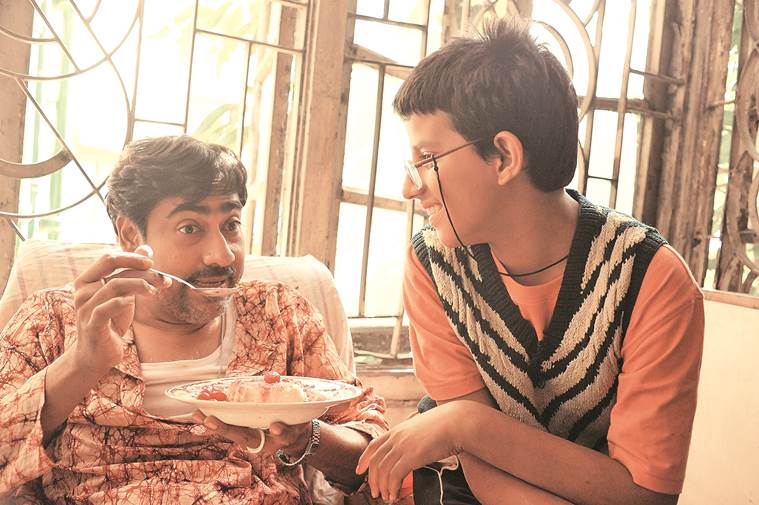 Mahabrata Basu with Kaushik Sen in Rainbow Jelly
The character of Ghoton has shades of Charles Dickens’ Oliver Twist, or Pip, and his red balloon, of Albert Lamorisse’s Le Ballon Rouge (1956). The film’s universal subject of boyhood modernises the fairy tale: flying planes instead of falling stars as symbolic of wish-fulfillment. Pori pishi’s (fairy aunt Sreelekha Mitra’s) box has magical tastemaker potions: sweet, sour, salty, spicy, pungent, astringent and bitter, in rainbow colours. These go into the meals Ghoton feeds Gondariya, each day of the week, triggering unique reactions. For this, Ghosal turned to Ayurveda, which says: “Don’t make medicine your food, make food your medicine.”
“When you’re in a foul mood, the food turns out bad,” says Ghosal, who loves cooking. “There have been many films on food but I don’t know if there has been any on taste theory, using different tastes to change people’s heart,” he says. The entire Pori pishi section, a dream sequence, is a tribute to Majumdar’s story Podi Pishi’r Bormi Baksho, and the taste-recording robot, a hat-tip to Ray’s science-fiction character Professor Shonku’s robot that records sriti (memory).
In Rainbow Jelly, Ghosal wanted to retain the essence of Sandesh-style illustrations, so he turned an animator, by taking YouTube tutorials. Ghosal has been an illustrator for magazines — Sandesh, Kishore Bharati and Robbar (then edited by the late Rituparno Ghosh). “As comics artists, we write sounds: Boom! Splash! The cinematic sound attracted and engulfed me,” he says.
Singer Moushumi Bhowmik introduced Basu to the crew. His 100-watt smile won Ghosal over, who says, “In the film, everyone maltreats Ghoton. I asked myself, ‘Why won’t a boy of today fight back?’ I wanted to see the world through the eyes of a special child.” Attacked by septicaemia after birth, Basu developed a neurological problem, with speech issues and low-reflex disorders. “His mother asked, ‘How many dialogues?’ I said, ‘Barring three-four scenes, Mahabrata is the entire film.’ She said, ‘Drop Mahabrata from the project. He doesn’t even know the concept of memorising, has never given exams or mugged up.’ But I insisted. Through constant sruti (narration), his mother fed him the dialogues. His sense of absorption is strong. It took him one month to learn.” But they had to redo since Basu was expressionless. “Their minds work at a faster pace than ours, and body is not in sync,” says Ghosal. Intense workshops over three months, eight hours a day, five days a week, preceded the 16-day shoot. “I employed the smiley method, drew emojis on sheets, raised them and shouted ‘angry, sad, happy’ during the shoot. It worked,” he says.
Quoting Andrei Tarkovsky, “cinema uses your life, not vice-versa,” Ghosal says, “life is finite, cinema is infinite.” And, Basu is an example of cinema’s transformational possibilities. All that mugging up of the dialogues helped develop his memory and in clearing the Class VII entrance test at Patha Bhavan. Before this, he was in a school with 15 other special-needs children, and no examinations.
A quintessential meaningless Bengali daaknaam (nickname), Ghoton is not an oghoton (disaster) with a “marginal IQ”, but a ghotona (phenomenon), making things happen. His dead father’s unfinished taste theory project. “Mahabrata taught me that our incompetences are our biggest enemies, we can’t let them win,” says Ghosal, “There’s a ‘child self’ in all of us. If the film reaches and touches everyone’s ‘child self’, then it’s a success.”
Comments
Post a Comment